mini-SWE-agent

mini-SWE-agent

The minimal software-engineering agent — 100 lines that beat giants

mini-SWE-agent is the radically minimal coding agent from the SWE-bench team: about a hundred lines of core logic, any model, shell-only tools — and benchmark results that rival full-size agents.

From the researchers behind SWE-bench, mini-SWE-agent strips agentic coding to its essence: a tiny, auditable loop where the model works through plain shell commands. That minimalism made it the standard harness for serious evaluation — it powers benchmark work like Ramp's SWE-Bench and has outscored much larger agents on independent evals. For automation, research, or understanding how agents actually work, small is the feature.

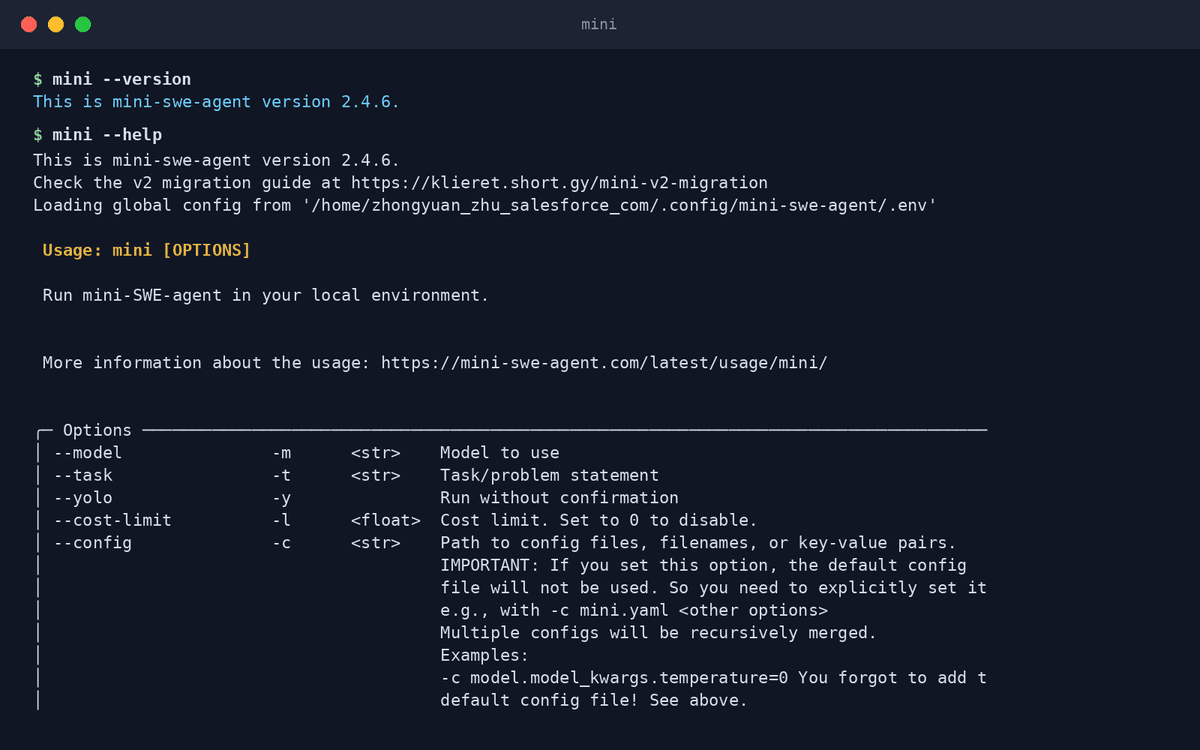
Real terminal output from mini-SWE-agent

Key features

  • ~100 lines of core logicThe whole agent loop is small enough to read over coffee.
  • Shell-only tool modelNo bespoke tools — the agent does everything through bash, like an engineer.
  • Any model via LiteLLMAnthropic, OpenAI, DeepSeek, local — swap with one setting.
  • Benchmark-grade harnessThe evaluation workhorse of the SWE-bench ecosystem.
  • Cost limits built inCap spend per run — friendly for batch and CI usage.
  • Scriptable batch modeRun it across many issues or repos programmatically.

What makes mini-SWE-agent different

1

Radical auditability

When you must know exactly what the agent did and why, a hundred readable lines beat a hundred thousand opaque ones.

2

The evaluators' choice

Independent benchmarks standardize on mini-SWE-agent as the harness — results with it are comparable and reproducible.

3

Proof that scaffolding is overrated

Its scores against far heavier agents are a running argument that model + shell is most of what matters.

Connect mini-SWE-agent to OpenAgents Workspace

In a Workspace, mini-SWE-agent stops being a solo tool: teammates and other agents can @mention it in shared threads, hand it tasks, and follow its work from any device. Connecting takes about two minutes:

  1. 1Install mini-SWE-agent from the Agents tab of the OpenAgents Launcher — one click, and the Launcher keeps it up to date.
  2. 2In the Launcher, open Workspaces and choose “Add a workspace”. Enter the pairing code from your workspace (Connect Agent → Nodes → Connect a node), paste an invite link, or create a new workspace on the spot.
  3. 3Done — mini-SWE-agent appears as a member of the workspace. @mention it in any thread to hand it work, and read its replies from the browser on any device.

Frequently asked questions

What is mini-SWE-agent?

A deliberately minimal software-engineering agent from the SWE-bench team: roughly 100 lines of core logic driving any LLM through plain shell commands, used widely for benchmarking and automation.

How do I install mini-SWE-agent?

Install it from the Agents tab of the OpenAgents Launcher with one click (or pip install mini-swe-agent). Configure a model key and it's ready.

Is it really competitive with big agents?

On SWE-bench-style tasks, yes — independent evaluations have shown it matching or beating far more complex agents, which is exactly the point it was built to make.

What is it best for?

Benchmarking models, batch-fixing issues, CI automation, research, and learning how agents work — anywhere simplicity, cost control, and reproducibility matter.

Can it collaborate with other agents?

Yes. In an OpenAgents Workspace it can take delegated issue-fixing tasks alongside your interactive agents — a lightweight specialist on the team.

Manage all your AI agents in one place

OpenAgents Launcher installs, updates, and connects your agents.

Visit mini-SWE-agent official site →