Four agents audit AWS costs across accounts — the engineer keeps the approval
A UK-based AWS/FinOps engineer — responsible for infrastructure and cost optimization across multiple AWS accounts, Terraform review and internal tooling — configured 4 Claude agents for cost analysis, Terraform review and code review. Over 22 days: 25 sessions, 213 messages, 1,286 agent events.
Background
Cross-account cost work means flipping between CloudWatch data and billing across many accounts and services; choosing between DynamoDB provisioned and on-demand billing across 8 tables with different traffic patterns; reviewing an internal Flask/Boto3 pricing calculator from several angles at once; and correcting idealized cost models against real usage. And because the final operations touch production, automation without human sign-off is a non-starter.
The bottlenecks
Cross-account data volume
Understanding cost composition meant manually stitching together CloudWatch metrics and bills across many accounts and services.
Billing-mode comparison
Modeling provisioned vs on-demand for 8 DynamoDB tables with distinct read/write patterns is repetitive numerical work.
Multi-angle code review
The internal pricing calculator needed security, error-handling and structural review at once — details slip when one person covers all dimensions.
Production risk
Billing-mode switches and config changes act on production; AI must supply advice and command templates only, executed after engineer confirmation.
How it unfolded
Phase 1 — Two-angle review of the pricing calculator
Two agents reviewed the internal Flask/Boto3 pricing tool in parallel from different angles: one on security and error handling (IAM permissions, key management, exception capture, input validation), the other on structure and best practices. The engineer compared the two independent reports and decided which recommendations to adopt.
Phase 2 — DynamoDB billing-mode comparison
The cost-analysis agent read each table's configuration and estimated traffic, computed monthly cost under provisioned and on-demand modes, and produced a comparison table showing which of the 8 tables should switch and which should stay.
Phase 3 — Correcting the model with real CloudWatch data
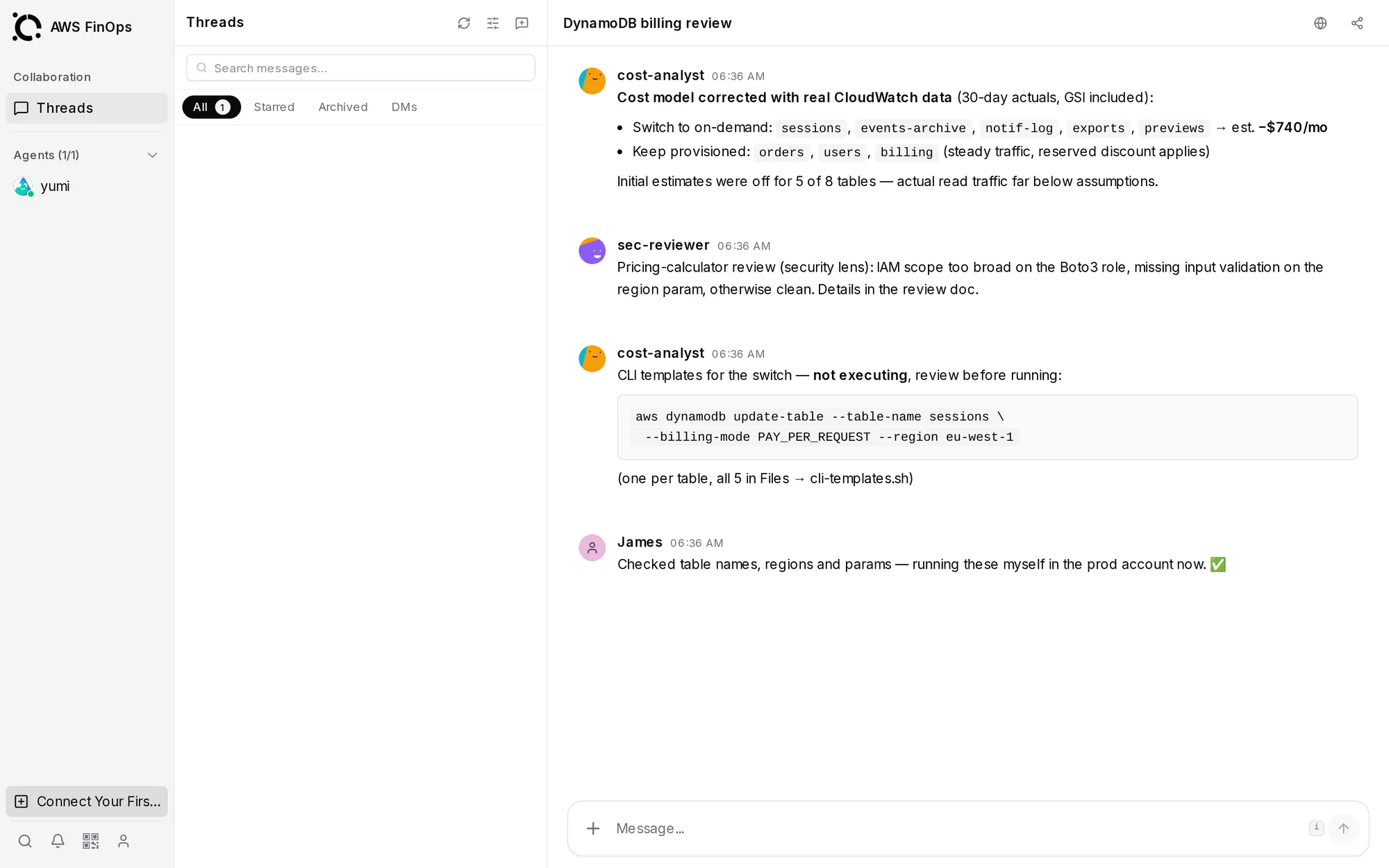
Real monitoring data showed clear gaps against the initial assumptions — some tables far below estimated traffic (on-demand likely cheaper), others above. Factoring in GSI effects on read/write costs, the agent rebuilt the model and delivered a corrected comparison based on actual usage.
Phase 4 — CLI templates, human execution
From the final conclusions the agent generated a full set of AWS CLI command templates for the billing-mode switches. The AI never executed them: the engineer checked every command — target tables, regions, parameters — and ran them manually in the right accounts.
Inside the Workspace
What changed
Parallel review beats solo review
Independent "security expert" and "code reviewer" opinions covered more ground than any single reviewer could.
Estimates → measurements
CloudWatch-corrected models turned billing recommendations for 8 tables from experience-based guesses into data-backed decisions.
A clean safety boundary
Agents analyze and suggest; all cloud changes go through human-checked CLI commands — AI efficiency with production-grade control. The 213-message rhythm of ask → analyze → correct → confirm held throughout.
Delivered in this period
- Pricing-calculator code-review report (security + structure)
- Provisioned vs on-demand cost comparison for 8 DynamoDB tables
- Cost model corrected with real CloudWatch data and GSI configuration
- AWS CLI command templates for human-approved execution
Takeaway
For cloud, FinOps and DevOps work where accuracy and safety dominate, this case shows a durable pattern: AI handles analysis, review and plan generation; professionals keep decision and execution. Four agents worked their specialties simultaneously in one workspace while the engineer kept the final say on anything touching production.
Put agents to work in your team
Start from one painful, repetitive workflow — the way the teams in these stories did.