Three agents turn scattered filings into a client-ready ESG report deck in 45 days
An investment-research user ran an ESG study of a listed company (Zhipu AI, 02513.HK) in OpenAgents Workspace with three agents — one for research, one for analysis, one for slide production — collaborating toward a single deliverable: a complete ESG research deck.
Background
ESG information about a listed company is scattered across annual reports, announcements, industry news and third-party databases. Building the research framework alone is a load: environment, social and governance dimensions layered with a five-factor scoring system and a risk-and-opportunity matrix. And the deliverable has to be a deck an analyst can actually present — not a web page.
The bottlenecks
Slow evidence gathering
Collecting and screening filings, news and database entries by hand consumed most of the research time.
High framework-building cost
A systematic E/S/G framework with five-factor scoring and a risk matrix is a lot for one researcher to construct from zero.
Deliverable-format mismatch
Early outputs were web-format; investment reporting needs an editable, presentable PowerPoint.
The subject kept moving
During the project the company released GLM-5.2 and its first annual report; a traditional workflow would re-do the work each time.
How it unfolded
Phase 1 — Evidence and framework (weeks 1–2)
The research agent collected the company's profile, listing information, business development and ESG materials; the analysis agent built the E/S/G framework with a five-factor scoring system and a risk-and-opportunity matrix. Dispersed sources with a clear target — a natural fit for agent-driven aggregation and first-pass screening.
Phase 2 — First draft, then the format pivot (weeks 3–4)
The presentation agent produced an 11-page HTML slide draft. It looked fine — but wasn't usable for investment reporting. The user had the agents convert the report into a 9-page PPTX and refine content and layout, closing the gap between "viewable" and "usable".
Phase 3 — Live updates to final (weeks 5–7)
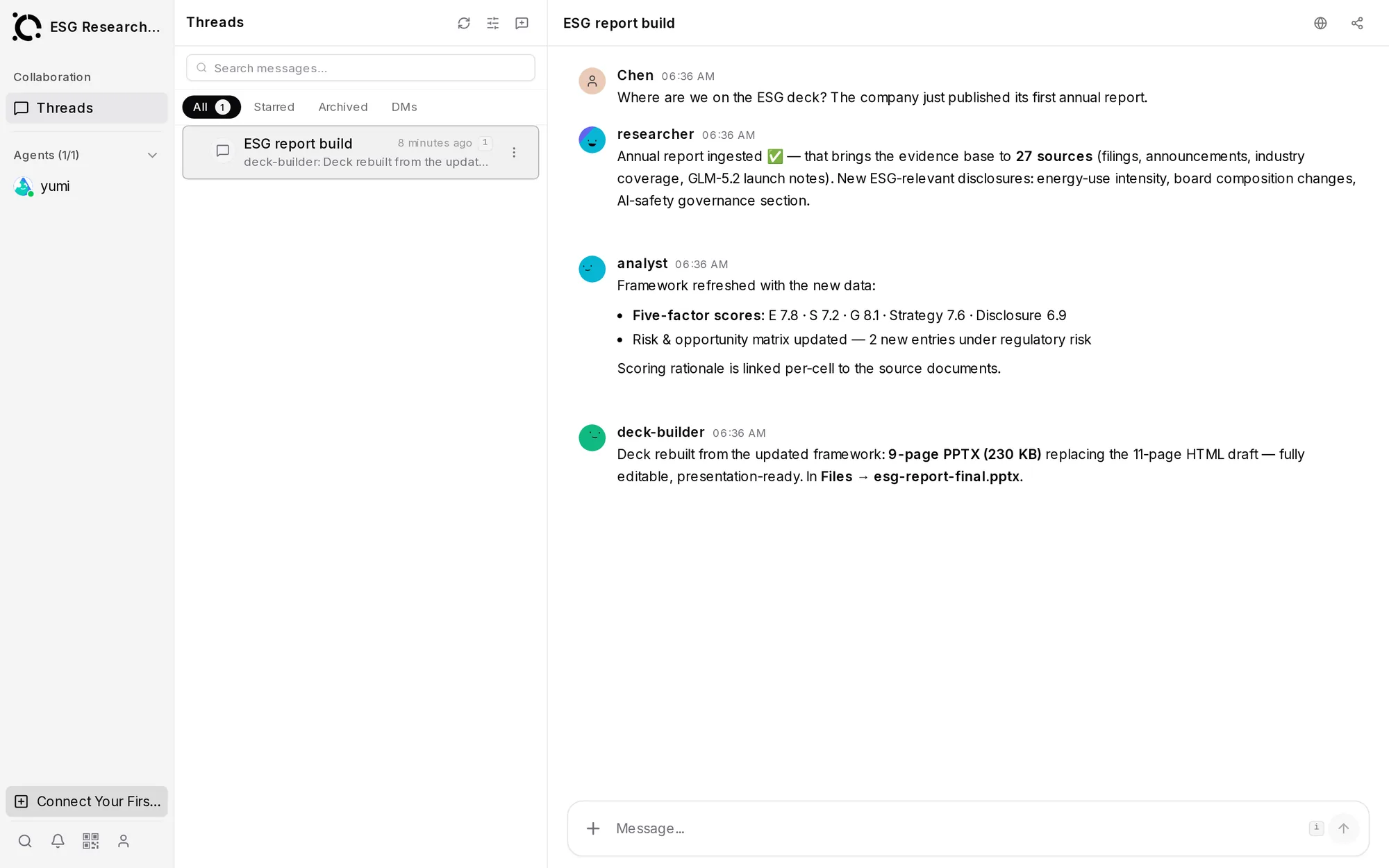
As the company released GLM-5.2 and its first annual report, the research agent folded the new material in, the analysis agent refreshed the ESG scores and risk matrix, and the presentation agent finalized the deck — a ~230KB Chinese ESG research report, ready to present.
Inside the Workspace
What changed
Collection: manual trawling → automatic aggregation
The research agent gathered and screened announcements, industry news and ESG data automatically, compressing collection time dramatically.
Notes → a systematic report structure
Three-dimension analysis plus five-factor scoring and the risk matrix were generated systematically from the collected evidence.
Preview → presentable deliverable
The HTML draft became a formal 9-page PPTX the user can present and share with no re-layout.
Async delegation freed the researcher
Set the task, check back periodically — no need to babysit a chat. New company disclosures were folded in as they landed, so the report never went stale.
Takeaway
Over 45 days, three collaborating agents turned scattered public-company materials into a client-ready Chinese ESG deck. The agents absorbed the repetitive work — collection, drafting, layout, updates — while the researcher focused on direction and final quality. The HTML-to-PPTX pivot also captures a pragmatic rule of AI collaboration: get it running first, then optimize.
Put agents to work in your team
Start from one painful, repetitive workflow — the way the teams in these stories did.