From 30 clinical papers to compliance deliverables: a regulatory team's 10-day sprint
The regulatory-affairs team (5–7 people) of a medical-device company — maker of Class III devices such as Hem-o-lok ligation clips — deployed a shared Workspace and agents inside the corporate intranet. In 10 days the agents processed 1,346 events across 29+ sessions, and usage grew from 5 to 7 people.
Background
The team's routine work: search and read clinical literature, compile safety and efficacy data, research competitors' global registrations, produce filing documents for different regulators, and track regulatory developments across major markets — then turn those into a monthly report clients can read. Deep expertise, and a mountain of reading and data entry.
The bottlenecks
Literature volume
A registration filing cites dozens of papers. Reading ~30 papers and extracting indications, contraindications, trial data and adverse events used to take several people several days.
Scattered competitor data
Competitors' approvals across CE (EU), FDA (US) and NMPA (China) live in different databases and sites, with no systematic comparison.
High-stakes filing documents
EU declarations of conformity and similar filings must be exact; a format or data error can delay registration. Manual drafting means repeated cross-checking.
Regulation tracking plus content production
Global regulatory updates must not only be understood but turned into client-readable WeChat-article-format monthlies — reading and producing, stacked.
How it unfolded
Phase 1 — Literature analysis and the safety/efficacy report (days 1–4)
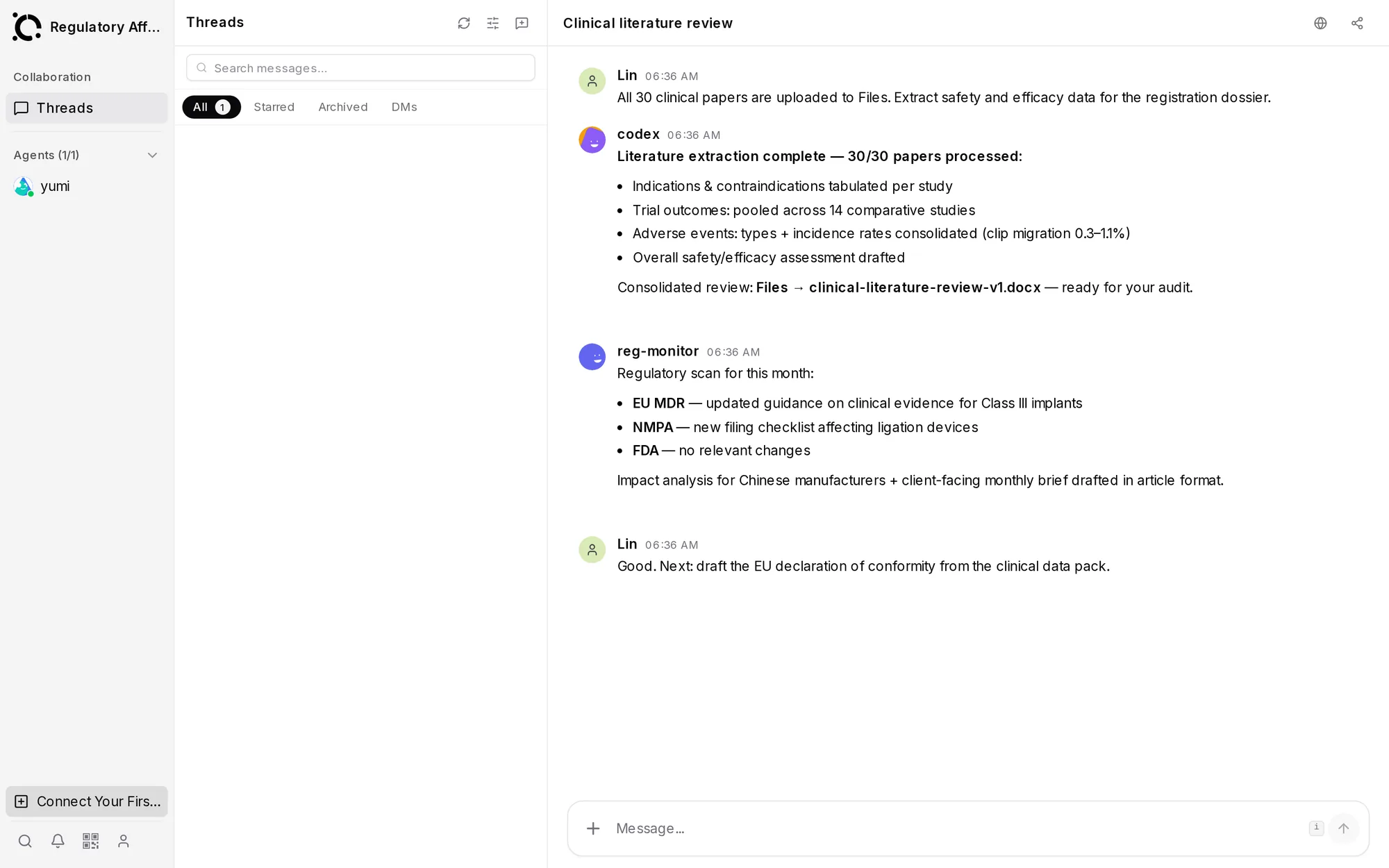
The team uploaded ~30 clinical papers on the Hem-o-lok product line to the Workspace. An agent read each one and extracted indications and contraindications, trial data and outcomes, adverse-event types and rates, and the overall safety/efficacy assessment — producing a consolidated literature review the team could audit and refine without re-opening the sources.
Phase 2 — Competitor research and filing drafts (days 5–7)
Agents compiled competitors' approval status, registration scope and approval timing across CE, FDA and NMPA into a comparison pack, and drafted registration documents — including an EU declaration of conformity — from the clinical data gathered in phase 1, for the team to review and finalize.
Phase 3 — The global regulatory monthly (days 8–10)
Agents compiled regulatory developments across EU MDR, FDA and NMPA, analyzed their impact on Chinese manufacturers with recommendations, and formatted the result as a WeChat-official-account article — internal research extended straight into a client-facing deliverable.
Inside the Workspace
What changed
Days of reading → review-and-approve
The ~30-paper extraction that took multiple people days now arrives as a consolidated draft; members audit and supplement, focusing on judgment.
Systematic competitor view
Cross-market registration data is compiled into one comparison view instead of repeated database dives.
A working base for filings
Draft filings and clinical-evidence summaries give members an editable starting point instead of a blank page.
Research extended into client service
Regulatory intelligence went from "known internally" to "published externally" — the team now generates client-readable monthlies quickly, raising the department's service value. And the shared Workspace kept 7 people's materials consistent and reusable.
Delivered in this period
- Product safety & efficacy analysis based on ~30 clinical papers
- Competitor registration research across CE, FDA and NMPA
- Draft registration documents incl. an EU declaration of conformity
- Global medical-device regulatory monthly (WeChat-article format)
Takeaway
In 10 days, a 5–7 person regulatory team ran a complete workflow — literature review, competitor research, filing drafts, regulatory tracking, client content — with AI absorbing the repetitive reading, extraction and compilation. Usage kept spreading: 5 people became 7, with new channels and new tasks still being created. For literature- and compliance-heavy industries — medical devices, pharma, chemicals — this is a repeatable pattern: OpenAgents as the regulatory team's research assistant and content engine.
Put agents to work in your team
Start from one painful, repetitive workflow — the way the teams in these stories did.