A 3-person dealership runs orders, sourcing and channel ops on one workspace — no code
A three-person dealership for a drone brand manages daily business in OpenAgents Workspace — from order tracking to building its own dealer-management system. Step by step, the workspace became the team's shared operations desk and materially raised its management efficiency.
Background
The team of three distributes a drone brand in its regional market — sales, purchasing, inventory and channel development. Its daily work spans order tracking and payment collection, supplier quotes and stock counts, dealer recruitment, market and competitor research, and a steady stream of marketing content. All of it used to live in scattered spreadsheets, documents and chat tools, held together by manual cross-checking.
With everyone playing salesperson, operations, marketing and admin at once, the time actually available for growing the business was being squeezed by routine chores.
The bottlenecks
Order tracking was manual
Overdue, unpaid orders had to be found by combing through spreadsheets row by row — easy to miss, and late collection hits cash flow directly.
Fragmented sourcing quotes
Quotes from multiple suppliers were scattered across email and chat history, with no systematic way to compare them.
No tooling for channel management
Dealer information, geographic coverage and partnership status lived in personal memory and stray documents — no global view.
Content production bottleneck
Nobody's job was content, yet the team constantly needed sales scripts, outreach emails and short-video scripts.
Repetitive checks drained focus
Daily order-status checks, inventory movements and model updates ate time that should have gone to business development. None of these tasks is hard alone; stacked together they wear a 3-person team down.
How it unfolded
Phase 1 — Start from the sharpest pain (weeks 1–2)
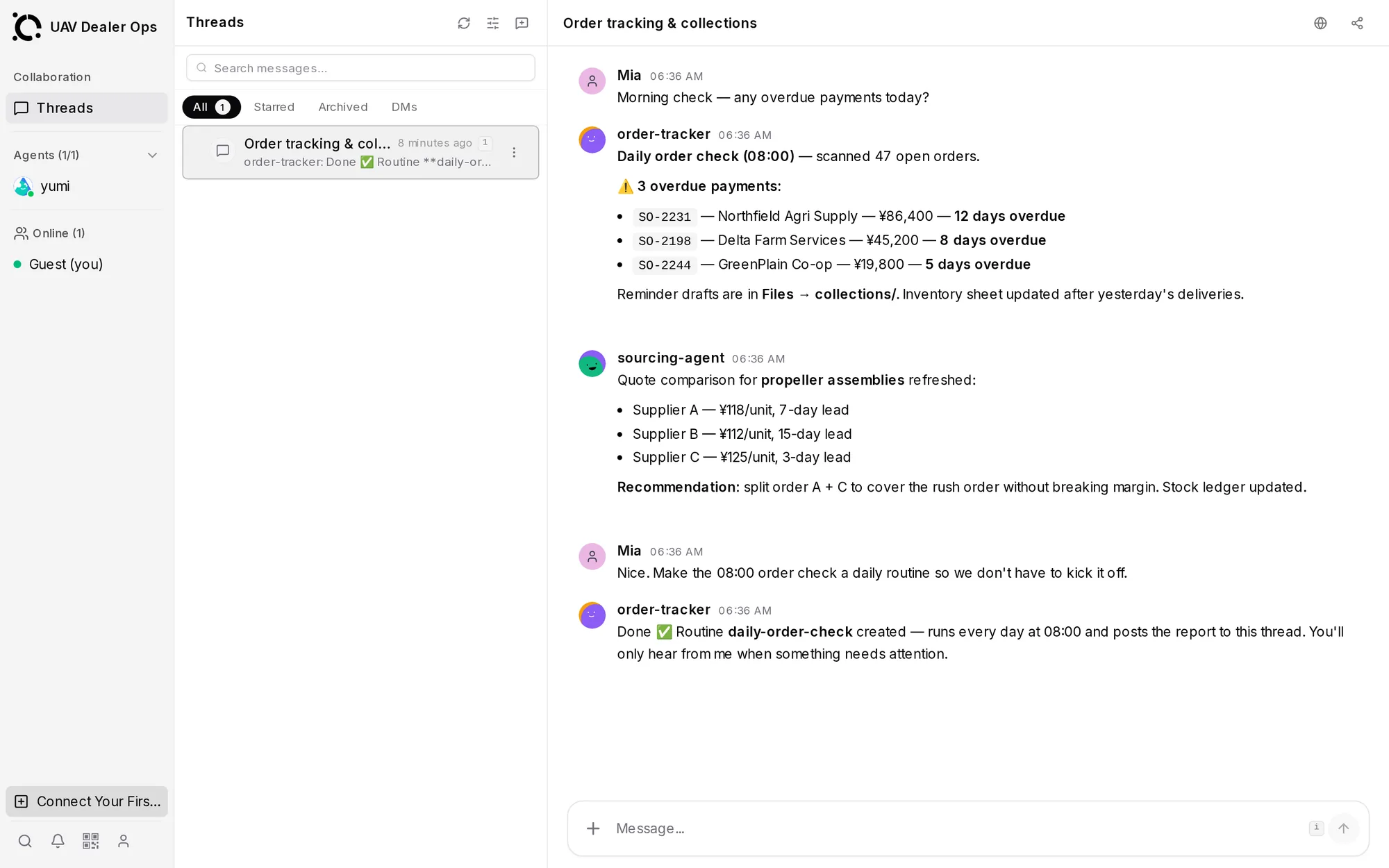
The team moved order management into the Workspace first: one agent reads the order sheet, filters out overdue unpaid orders and generates collection reminders; another consolidates supplier quotes, compares prices and updates inventory records. Both workflows share the traits that suit AI best — clear rules, structured data, high repetition.
Routines (scheduled tasks) were set up so the system runs the daily order check and model-status monitoring by itself — no one has to kick it off.
Phase 2 — From one workflow to the whole business (weeks 3–5)
With orders and sourcing stable, more of the business moved in: an agent builds dealer-distribution maps and regional market data for channel decisions; another collects competitor intelligence and drafts research reports; a third writes sales scripts, outreach emails, product copy and short-video scripts. Each agent owns a business area while the three teammates track progress, share files and coordinate in one Workspace.
Phase 3 — From operations to building software (weeks 6–7)
As usage deepened, the team started turning dealer management itself into a system — multiple agents collaborating to build a GDMS (dealer-management system) — and extended into ComfyUI content creation, video editing and marketing assets. In early July the team migrated to a new Workspace as the business grew; all three members kept working without interruption.
Inside the Workspace
Feature demo
What changed
Routines took over the repetitive work
Overdue-order checks and model-status monitoring run automatically; members only step in on exception alerts. Roughly 30–60 minutes of daily checking compressed to a few minutes.
One shared information plane
Business information that used to live on personal laptops, in chats and email now sits in shared files and message streams. Everyone can see each other's progress and every agent's output; coordination cost dropped visibly.
Usage expanded on its own
From orders to channels, research, content and finally software development — driven entirely by the team, with no outside implementation help. The learning curve was low enough for business people to explore new uses themselves.
AI became a participant, not a Q&A tool
Instead of one-shot question-and-answer, multiple agents participate in the business continuously — reading data, generating reports, updating files and running checks every day.
Takeaway
In 51 days, a non-technical team of three independently grew the Workspace from a trial tool into an operations desk covering supply chain, channels, marketing and development. Small teams don't need an all-at-once digitalization plan or an implementation crew: start from the pain point, hand the most repetitive work to AI first, and discover the rest along the way.
Put agents to work in your team
Start from one painful, repetitive workflow — the way the teams in these stories did.