A 12-person R&D team turns OpenAgents into an enterprise multi-agent platform in 22 days
A 12-person enterprise R&D team ran OpenAgents in a dual-track setup — local development plus corporate intranet. Across 22 days (19 active, 17 consecutive at the longest) they generated 100+ sessions and 15,025 events, building agent-runtime management, requirement management, agent squads, member management, automation flows, health checks and autonomous multi-agent group chat on top of the platform — and connected it to the company's internal project-management system.
Background
The company didn't lack AI capability — it lacked a collaboration layer that could bring AI into its existing R&D processes under enterprise management and security requirements. Business requirements lived in an internal project-management system with no bridge to AI execution; agents were scattered across environments with no unified monitoring; and external SaaS couldn't meet intranet-security and data-compliance needs.
The bottlenecks
PM system disconnected from AI
Requirements needed repeated manual relaying from the PM system into any AI workflow.
No unified agent view
Runtime status, task progress and health across scattered agents couldn't be centrally monitored — problems surfaced late.
No structure for collaboration
Complex projects exceed a single agent, but without grouping and assignment mechanisms multi-agent work turns chaotic.
Enterprise deployment constraints
Needs private deployment, intranet security and deep integration with existing IT — plus automation so requirement analysis, code review and test feedback don't rely on humans pushing them along.
How it unfolded
Phase 1 — Local development and feature build-out (weeks 1–2)
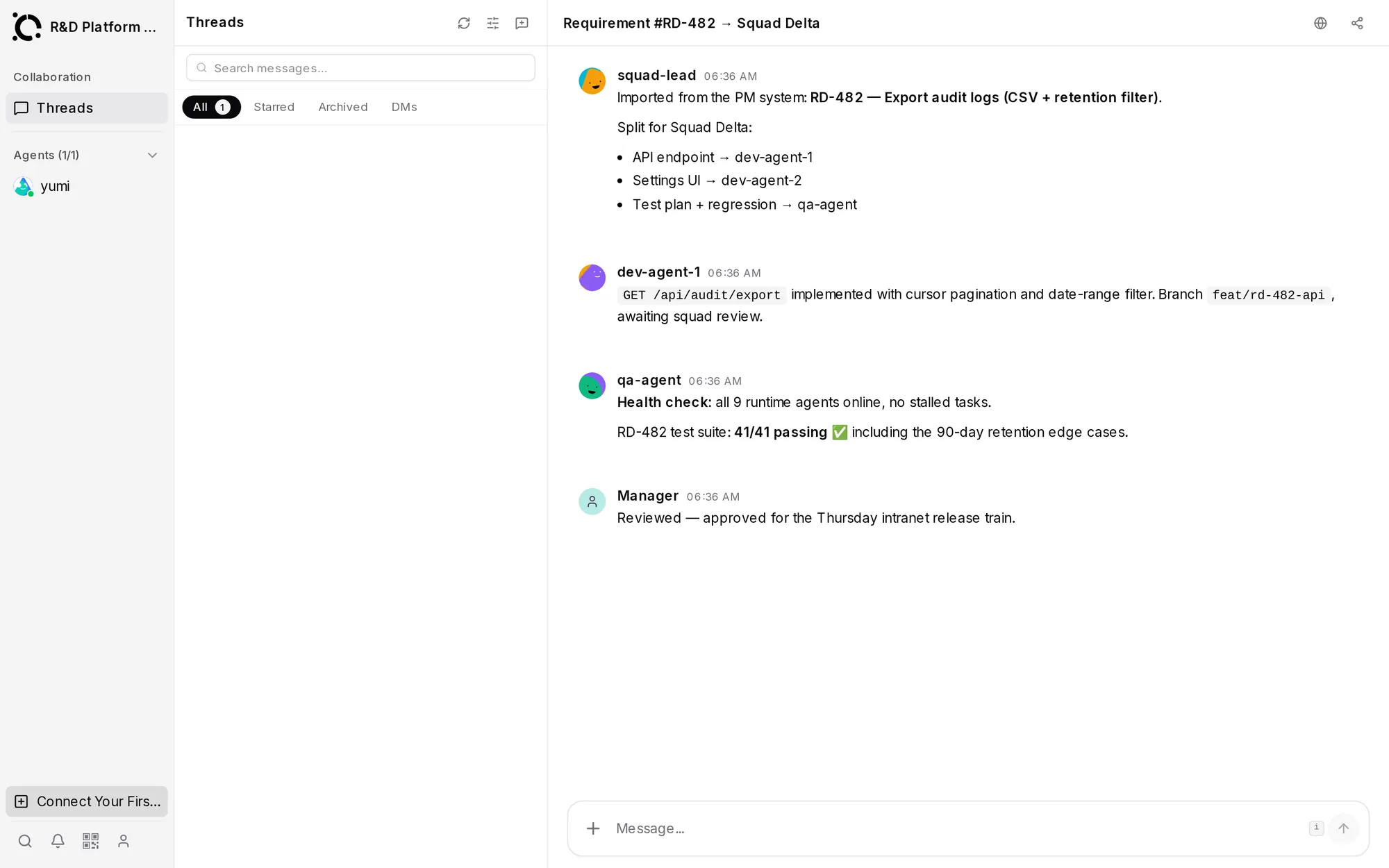
The team extended OpenAgents locally with runtime management, requirement management, agent squads, member management, automation flows, health checks and autonomous group chat — the goal being full R&D collaboration support, not single-conversation interaction.
Phase 2 — Wiring in the internal systems (weeks 2–3)
The platform was connected to the internal project-management system so business requirements flow directly into multi-agent workflows — no more copy-pasting into AI tools. AI collaboration stopped being a bolt-on and became a step inside the existing management process.
Phase 3 — Intranet deployment, 12 people in daily use (week 3+)
The adapted platform went onto the corporate intranet, where all 12 members tested and used it — 17 consecutive active days and 15k+ events, far beyond a product trial. Members grouped agents into squads for requirement analysis, development, testing and review, with runtime management and health checks providing a single pane over every agent's status.
Inside the Workspace
What changed
Single AI tool → enterprise platform
OpenAgents became the substrate carrying project management, agent grouping and runtime monitoring — a complete AI collaboration management layer from requirement intake to delivery.
Requirements flow without relays
PM-system integration eliminated manual relaying — from "people find AI" to "the system assigns".
One pane for all agents
Runtime management and health checks replaced per-environment logins, cutting operational load significantly.
Squads instead of lone agents; automation instead of pushing
Squad grouping organizes AI resources by project complexity with clear task boundaries; automation flows and autonomous group chat keep repetitive processes running by rule, so members intervene only at exceptions and key nodes.
Takeaway
In 22 days, a 12-person team transformed OpenAgents from a conversational tool into an intranet-deployed multi-agent collaboration platform integrated with the company's own project management. Enterprises don't need to build AI collaboration infrastructure from zero: second-stage development on OpenAgents gets them a compliant, process-native platform — from local dev to intranet deployment, from single conversations to system-level integration.
Put agents to work in your team
Start from one painful, repetitive workflow — the way the teams in these stories did.