A self-diagnosing personal knowledge OS, governed by a three-agent 'constitution'
An advanced user with deep multi-agent experience built a personal knowledge-management system he calls the "OB Three-Brain OS". Over 7 consecutive days (20 sessions, 689 events — 81 of 82 messages in the first two days), he governed three agents through a SOUL.md "constitution": john judges and gives final review, tom executes commands and queries data, Codex implements code. Rule one: facts go to tom, decisions go to john.
Background
Maintaining a personal system alone demands full-stack range: memory monitoring, knowledge-base services, monitoring scripts, data-consistency checks — querying, judging and coding in constant rotation. And piling agents on without order creates its own failures: edits falsely reported as successful, agents overwriting the same module, files written to the wrong directory, fixes without independent review that "break again after repair".
The bottlenecks
Solo full-stack maintenance
Query, judge, code — one person switching contexts continuously.
Disorder among agents
Without task ownership and conflict handling, concurrent agents duplicate and collide.
Priorities were guesswork
Which anomaly is a P0 and which can wait needs global information, not gut feel.
Message silos across entry points
Agents reached via Feishu couldn't see each other's messages; the user had to relay by hand.
How it unfolded
Phase 1 — Write the constitution, run the diagnosis (days 1–2)
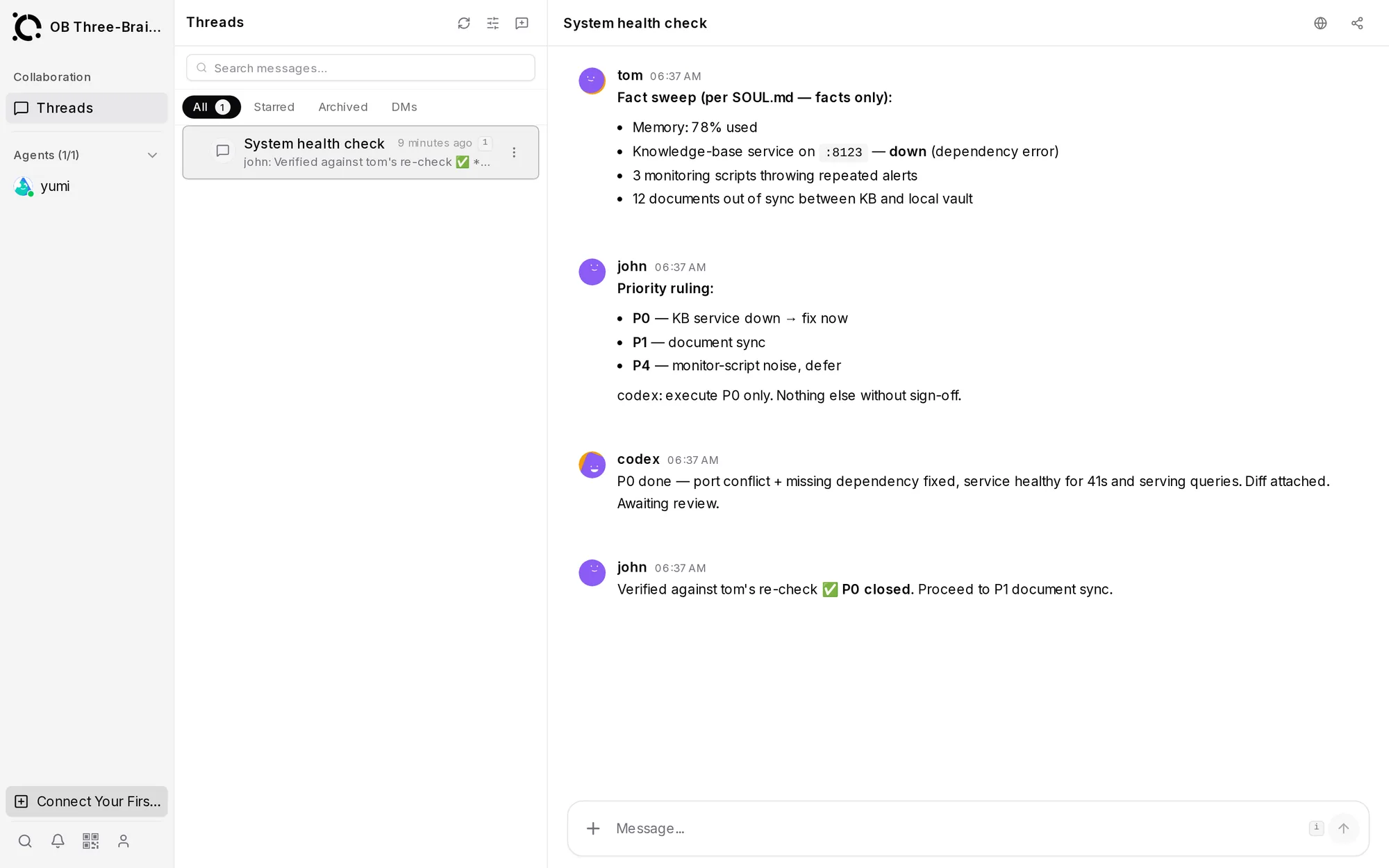
SOUL.md fixed each agent's authority: tom collects facts (memory usage, running processes, knowledge-base service status, monitoring scripts); john grades every finding P0–P4 and decides what gets fixed now. Rules first, data-driven, decisions ranked — the burst of 81 messages in two days was the user building this frame.
Phase 2 — Fixes and the Feishu message relay (days 2–5)
Codex executed only john-approved tasks: fixing knowledge-base ports and dependencies, tuning monitoring scripts to cut false alerts, repairing data inconsistencies between the knowledge base and local documents. The three agents also designed a Feishu ACP message relay so agents on different entry points can finally see each other.
Phase 3 — Final review and wind-down (days 5–7)
john re-checked every fix as the independent reviewer; the system settled into stable operation with only occasional check-ins from the user.
Inside the Workspace
What changed
Solo full-stack → separation of powers
tom queries, john judges, Codex codes; the user supervises the rules and reviews key nodes instead of playing ops, dev and architect at once.
Ranked priorities, independent review
P0–P4 grading ended scattershot fixing; john's final-review step cut the odds of "fixed then broken again".
Execution gated on approval
Codex changes nothing without an approved task — no unauthorized edits to the system's configuration.
The relay reconnected the chain
With the Feishu ACP relay, agents on different entry points perceive each other's messages; the user stopped relaying by hand.
Takeaway
Seven days, three role-cast agents, one constitution — a personal system that diagnoses and repairs itself through an execute → decide → review loop. The deeper lesson: when multi-agent collaboration meets reality, authority boundaries, task ownership, conflict handling and review mechanisms matter as much as raw agent capability.
Put agents to work in your team
Start from one painful, repetitive workflow — the way the teams in these stories did.